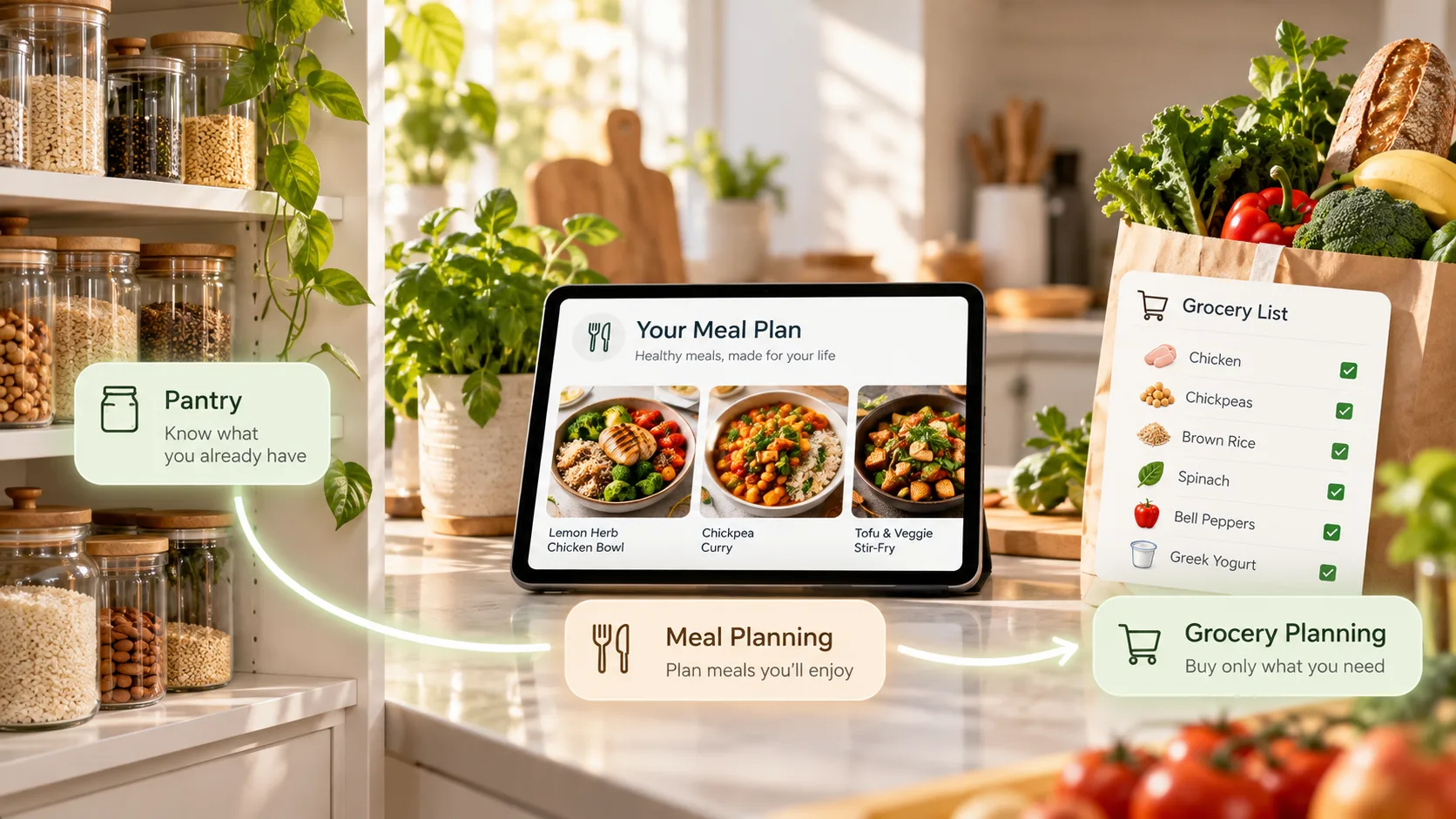
Most grocery lists answer one question:
What do I need to buy?
But there is another question that should come first:
What do I already have?
That sounds simple, yet many meal-planning and grocery workflows treat those two questions as completely separate problems.
You choose meals. A grocery list is generated. Then you walk into the kitchen and realize you already had rice, half a bag of spinach, chicken in the freezer, yogurt in the fridge, and three cans of beans hiding in the pantry.
So you either buy things twice, manually cross items off the list, or try to remember everything before leaving for the store.
We think there is a better way.
A Grocery List Should Start With What You Already Have
Imagine your meal plan says you need 500 grams of chicken for the week.
If you already have 300 grams at home, your grocery list should not simply tell you to buy 500 grams.
It should understand:
- 500 g needed for your planned meals
- 300 g already available at home
- 200 g still needs to be purchased
That difference sounds small, but it changes the entire grocery-planning experience.
Instead of creating a shopping list from recipes alone, the system can create a list from the gap between what your meals require and what your kitchen already contains.
Your Kitchen Is Part of the Planning System
A pantry is often treated like a static inventory list.
But ingredients do not simply exist “at home.” They live somewhere.
Chicken may be in the freezer. Yogurt belongs in the fridge. Rice may be in the pantry. Bananas may be sitting on the counter.
When those locations are understood, the kitchen becomes much more useful than a long list of ingredients.
You can answer practical questions more quickly:
- What is in my fridge?
- What do I already have for tonight’s dinner?
- What is sitting in the freezer?
- What should I use soon?
- What actually needs to go on my shopping list?
This is the direction we are building toward with FuelOra: not separate tools for meals, groceries, and pantry inventory, but one connected everyday workflow.
Why Traditional Grocery Lists Create Duplicate Buying
Recipe-based grocery lists are useful, but they usually begin with an assumption:
If the recipe needs an ingredient, you need to buy it.
Real kitchens are messier than that.
You may already have more than a recipe needs. You may have only part of it. You may have the same ingredient split between the fridge and freezer.
Without that context, a grocery list can easily become a list of recipe ingredients rather than a list of what you genuinely need to purchase.
That creates several familiar problems:
- Buying ingredients you already own
- Forgetting partially used ingredients
- Accumulating duplicate pantry items
- Spending more than necessary
- Letting older ingredients go unused
Partial Coverage Matters Too
Pantry awareness is not only about marking an ingredient as “have it” or “don’t have it.”
Quantities matter.
If dinner requires 500 grams of an ingredient and you have 300 grams, the useful answer is not simply:
Already at home.
And it is not:
Buy 500 grams.
The useful answer is:
300 g at home · Buy 200 g
That is a much closer reflection of how people actually shop.
Shopping Should Update the Pantry Too
The connection should work in both directions.
Before shopping, your Pantry can help determine what needs to be purchased.
After shopping, the groceries you actually buy should be able to return to the Pantry.
That creates a continuous loop:
Plan meals → check what is at home → buy what is missing → put groceries away → update what is at home.
The next meal plan can then begin with better information.
Just as importantly, picking an item up in the store should not automatically mean it is safely recorded in your kitchen. A shopping action and a confirmed purchase are not always the same thing.
The goal is not simply automation. The goal is accurate automation.
This Can Also Help Reduce Food Waste
Food waste often starts with a visibility problem.
Ingredients are forgotten because we do not remember they are there, where they are stored, or how much remains.
A connected Pantry can eventually help surface ingredients that should receive attention sooner, especially when real expiry information is available.
That opens the door to a more useful question than:
What recipe should I make?
Instead:
What can I cook using what I already have, especially the ingredients I should use soon?
And if that meal needs two ingredients you do not have, those two ingredients — not the entire recipe — can become part of the grocery list.
The Bigger Idea Is Connection
Meal planning is useful.
A grocery list is useful.
A pantry tracker is useful.
But the real value appears when they understand each other.
A planned meal creates ingredient demand.
Your Pantry shows how much of that demand is already covered.
Grocery identifies the remaining gap.
Your purchase updates the Pantry.
Cooking then uses those ingredients.
That is much closer to how everyday life actually works.
What We’re Building With FuelOra
FuelOra is being built around the idea that everyday wellness should feel connected rather than fragmented across a collection of unrelated tools.
Meals, groceries, Pantry, cooking, nutrition and everyday wellness decisions influence one another.
So instead of asking users to repeatedly enter the same information in different places, we want each part of FuelOra to provide useful context to the next.
There is still a lot more we want to build, but this connection between meal planning, Pantry and Grocery is an important part of that foundation.
Because a smarter grocery list should not begin in the grocery store.
It should begin with understanding what is already in your kitchen.