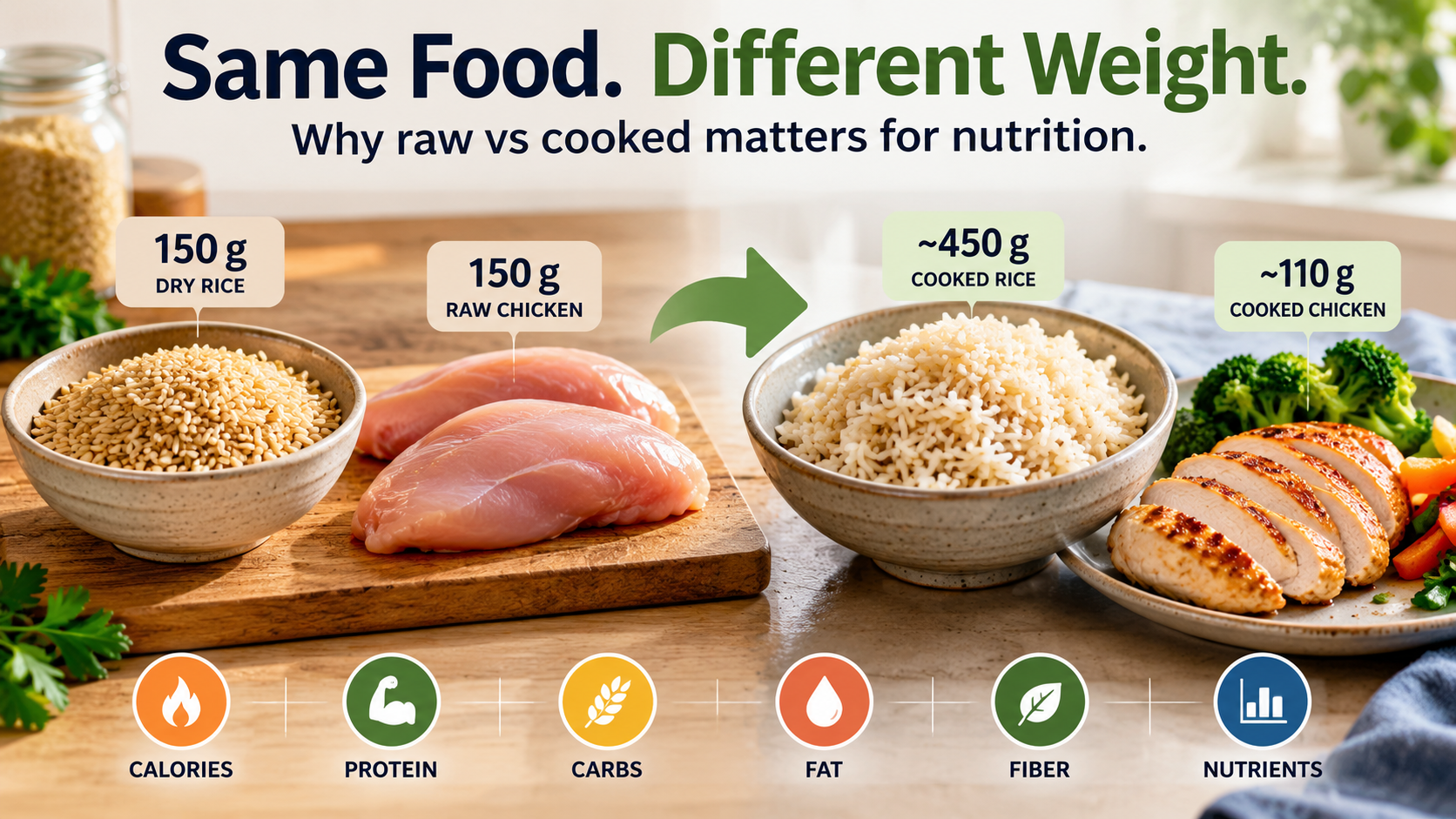
You weigh 150 grams of rice, log it into a nutrition app, and move on with your day.
Simple enough.
But there is one important question that can completely change the answer:
Was that 150 grams of rice dry—or already cooked?
The difference can be substantial.
This is one of the less obvious parts of nutrition tracking. The same food can have very different calories, carbohydrates, protein, and nutrients per gram depending on its physical state when it is measured.
Understanding that difference can help you interpret nutrition information more clearly, plan meals more accurately, and make everyday food tracking much more meaningful.
Why raw and cooked weights are different
Cooking changes food.
Some foods absorb water. Others lose water. Some lose fat or other components during cooking. As a result, the number on the kitchen scale can change even though you are still looking at the same basic ingredient.
Rice is one of the easiest examples.
Dry rice absorbs a significant amount of water as it cooks. The cooked rice therefore weighs much more than the dry grains you started with.
Water adds weight, but it does not add calories.
That means 100 grams of cooked rice generally contains far fewer calories than 100 grams of dry rice.
The food did not suddenly lose most of its energy. The energy is simply distributed across a larger cooked weight because the rice absorbed water.
Meat often works in the opposite direction
Meat usually loses water as it cooks.
Imagine starting with a piece of chicken breast and cooking it until it reaches a safe internal temperature. During cooking, moisture is lost and the final piece weighs less.
Because the cooked portion contains less water, nutrients such as protein can appear more concentrated per 100 grams.
So 100 grams of raw chicken and 100 grams of cooked chicken should not automatically be treated as the same thing when calculating nutrition.
The important question is: what did you actually measure?
Nutrition tracking works best when the nutrition data matches the physical state of the food you measured.
If you weigh rice before cooking, the nutrition reference should describe dry rice.
If you weigh rice after cooking, the reference should describe cooked rice.
The same principle applies to many everyday foods:
- Rice
- Pasta and noodles
- Lentils and beans
- Chicken
- Beef
- Pork
- Fish
- Oats and grains
A food name by itself is sometimes not enough.
“Brown rice” can refer to dry grains sitting in your pantry or cooked rice sitting on your plate.
Those are two very different measurements.
Why this matters beyond calorie counting
When people think about nutrition accuracy, calories usually get most of the attention.
But preparation state can affect much more than calories.
It can change how you interpret:
- Protein
- Carbohydrates
- Fat
- Fiber
- Vitamins
- Minerals
And once nutrition information is used to plan an entire day or week, a small misunderstanding at the ingredient level can become a much larger difference across multiple meals.
A simple example: dry rice versus cooked rice
Imagine a recipe that calls for 150 grams of brown rice.
If that means 150 grams of dry rice, the recipe is starting with a relatively concentrated amount of energy and carbohydrates.
After cooking, that rice may weigh several times more because it has absorbed water.
If instead the recipe means 150 grams of already-cooked rice, the actual amount of dry grain used is much smaller.
Both measurements are perfectly valid.
The problem begins when the ingredient quantity describes one state while the nutrition data assumes another.
Clear recipes should remove that ambiguity
A useful recipe should help you understand exactly what you are measuring.
Instead of simply saying:
Brown Rice — 150 g
a clearer recipe might indicate:
Brown Rice — 150 g dry
or:
Brown Rice — 150 g cooked
That small detail makes the recipe easier to cook and the nutrition easier to understand.
Consistency matters more than perfection
Nutrition information will always contain some natural variation.
Different varieties of food, cooking methods, brands, moisture levels, and portion sizes can all produce slightly different numbers.
The goal should not be to pretend that every meal can be measured with laboratory precision.
The goal is to make the information internally consistent and useful.
If an ingredient is measured raw, use nutrition that represents it raw.
If it is measured cooked, use nutrition that represents it cooked.
That simple principle makes the rest of the nutrition picture far easier to understand.
Think beyond the number
Food tracking should not become an exercise in chasing perfect numbers.
What matters more is having enough clarity to understand your meals, recognize patterns, and make better decisions over time.
Knowing whether an ingredient was measured dry, raw, cooked, or prepared is part of that clarity.
It connects the recipe you cook in the kitchen with the nutrition information you see on the screen.
How FuelOra thinks about everyday nutrition
At FuelOra, our goal is not simply to show you numbers.
We want to help connect the entire meal:
- what you plan to eat,
- the ingredients you use,
- how you prepare them,
- what you actually eat, and
- what that means for your overall wellness.
That is why details such as ingredient quantities, preparation, servings, macros, and micronutrients matter.
When those pieces work together, nutrition becomes easier to understand—not more complicated.
One simple habit to try
The next time you weigh rice, pasta, meat, or legumes, ask yourself one question before logging it:
Am I measuring this before or after cooking?
That one habit can make your food tracking considerably more meaningful.
Better wellness does not always come from tracking more.
Sometimes it comes from understanding what you are already tracking a little better.
Good food. Clearer choices. Brighter days.